

THE BRAND
VALUE SYSTEM
FROM PROMISE TO PROOF
8-10 MINUTE READ. PUBLISHED 2 FEB 2026. UPDATED 22 MAR 2026.
CREATIVE COMMONS CC BY ELECTRO STRATEGY STUDIO. WRITTEN BY ADRIAN JARVIS.
TL;DR Brand design is founded on value delivery, and value chains decide whether your promise survives contact with reality. As markets shift to partner ecosystems, brands become a working system across propositions and proof at the moments of truth. Here is a short field guide to that shift and designing a Brand Value System.
EXPLORING THE ROLE OF VALUE CHAINS IN BRAND DESIGN.
Brand design, at its heart, is the design of value. How a company's products, services, people, and partners connect in ways that customers decide to pay a premium for... and choose one company over another.
In simple terms, value chains are the engine behind turning inputs into profit; the end-to-end activities and relationships that create economic value. For decades, the focus has been on optimising processes and relationships to build a competitive advantage, especially at points that value is amplified or evaporates in ‘the chain’.
An illustration of a value chain might be... an elevator company that designs and builds mobility systems for high-rise buildings. It sources steel and electronics to manufacture and ship components for local installation, while keeping the systems running across the building lifecycle through planned service and modernisation.
The intersection between brand design and value chains should be seen as 'value by design'. Operational choices such as materials, service delivery and supply chain conditions are balanced with strategic considerations such as positioning and pricing.
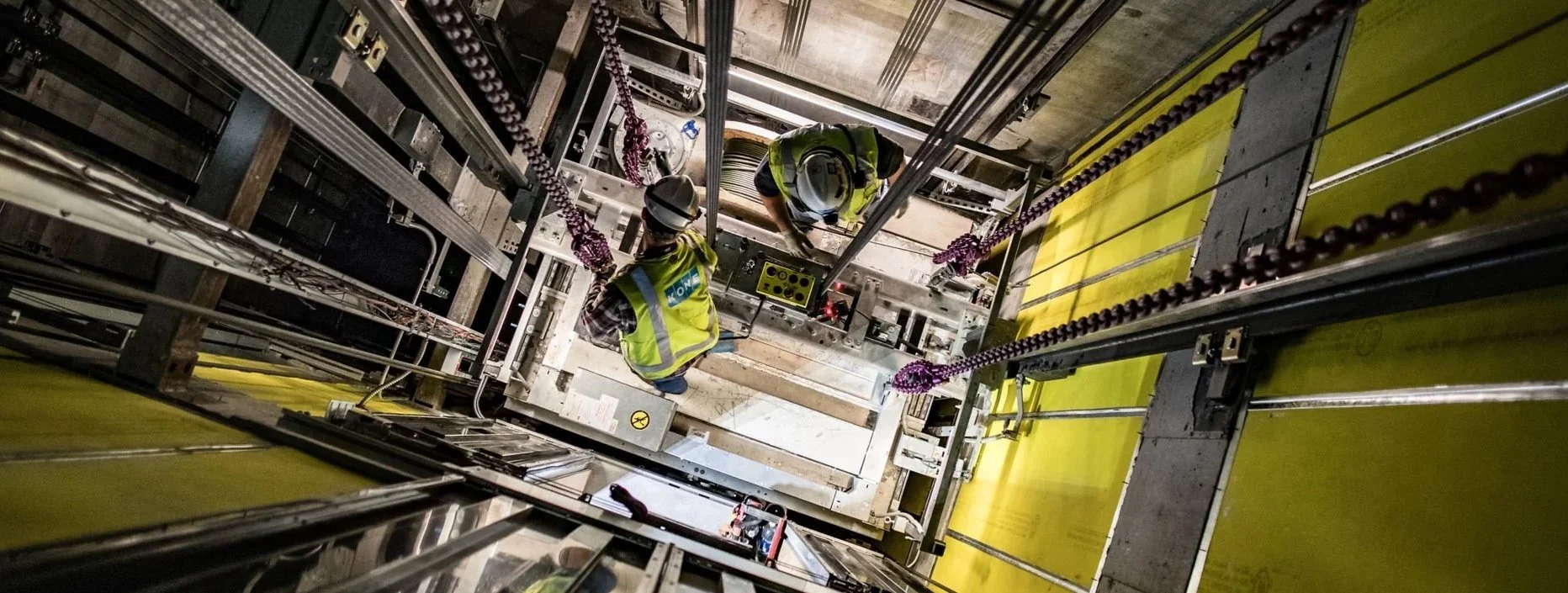
CREDIT: Kone Oyj, Finland
Value Proposition and The Value Chain.
A key deliverable for brand strategy is a value proposition. A statement that defines what customers should expect in terms of value delivery, based on moments directly reflected by the value chain; sourcing, quality, reliability, consistency, service, sustainability, partnerships...
An illustration of a value proposition might be... an ingredient brand such as Woolmark, where the mark signals a defined standard for the fibre quality and garment performance. The value proposition is the symbol of the value chain: it turns sourcing, grading, processing, manufacturing, and certification into a value cue on the finished product. Customers pay a premium for verified quality and view the mark as more than a marketing ploy.
So, brand design becomes symbiotic; both shaping and being shaped by the value chain. The aim is to ensure that customer value is built through the tangible delivery of the value proposition... while driving commercial targets, such as scale and margin.

CREDIT: The Woolmark Company, Australia
From Value Chains to Value Ecosystems.
A value chain is generally seen as the end-to-end ‘work’ that turns inputs into something a customer buys. Though as digital transformation accelerates, more propositions depend on value ‘ecosystems’. These are networks of networks; organisations that cooperate and compete to deliver joined-up outcomes. The challenge becomes how to maintain brand cohesion, especially when by design you don't own all the brand touch-points.
An illustration of a value ecosystem might be... a MedTech entrant keeping patients stable at home, while giving clinicians early warnings of changes to a specific condition.
To deliver the proposition, the brand has to earn its role in an ecosystem of clinics, general practitioners, payers, distributors, record platforms, regulators, manufacturers. For new technology to solve customer pain-points, delivery relies on a wider system of providers — each with the potential to create or destroy value, beyond the device.

CREDIT: Red Dot Design Awards / Shenzhen Homed Medical Device Co, China
DESIGNING A BRAND VALUE SYSTEM.
Brand design defines the value proposition. Value chains and ecosystems decide whether that promise holds up in the real world. In markets shaped by technology, platforms, and partner networks, brands become a value system you design, build, and manage.
Brand design should be the operating protocol that provides verifiable proof of customer value. By treating the brand as a system, companies are encouraged to integrate three typically siloed functions:
The promise customers hear.
The solutions businesses create.
The proof customers see.
However in practice, more systemic brand design often faces entrenched thinking and silos. The friction between functions and factions is a primary point of failure. Commercial success requires deliberately designing to shared objectives, clear workflows and aligned rewards.
When a Brand Value System fails, it is often in predictable ways. The most evident is the ‘experience gap’ which opens when a brand promise outruns proof. Creating a reason for customers to look at competitors’ products and services, to see whether they better meet their needs.
When done effectively, a Brand Value System links products, services, and experiences to the operating model; designing brands that customers choose and recommend. So that the true measure of brand value goes beyond saliency, to be captured in the appreciation and depreciation of unit economics; such as, Customer Acquisition (CAC), Pricing Power (PED), Recurring Revenue (MRR), and Lifetime Value (LTV).
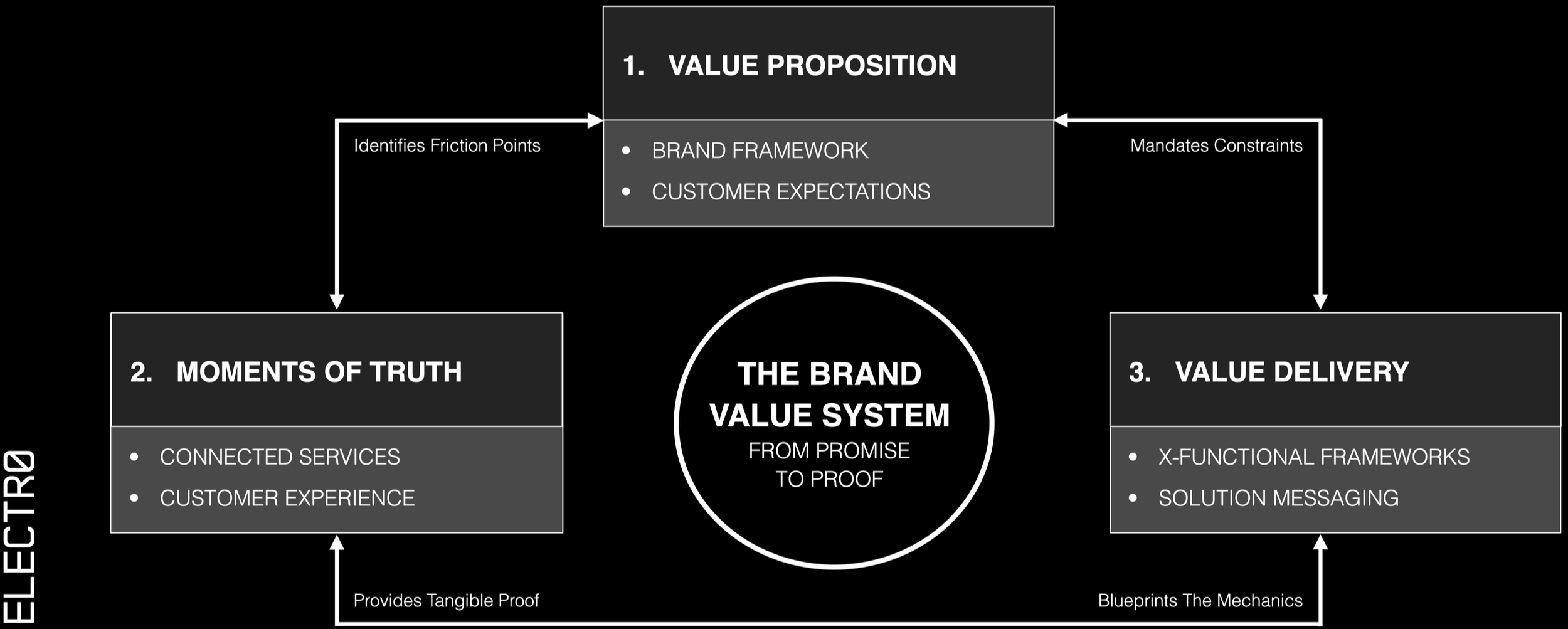
1. DESIGN THE VALUE PROPOSITION.
Start by defining the outcome to be delivered, with any trade-offs.
A useful working method is to write the value proposition, listing the minimum conditions required to make it operationally true. Use ideal and non-negotiable constraints to explicitly tie the proposition to the value chain. This forces clarity: stopping over-claim, reducing a focus on edge cases, and ensures that we reject profitable yet brand-eroding opportunities.
Task: In a sentence, define the value proposition. Write versions for each audience through the value chain, with ranked constraints.
Toolkits: Value Proposition Canvas, Customer Segmentation, Value Chain Analysis
2. DESIGN AT MOMENTS OF TRUTH.
Decide where trust is won and lost, designing the experience at those moments.
Focus on high-friction points where value decisions are made. Build proof into the journey so customers can make informed choices and take action. Make proof concrete and treat these points as core brand experience and service features, not just marketing concepts.
Task: Choose 3 x moments of truth, then design the value signals for each.
Toolkits: Customer Journey Mapping, Voice of the Customer
3. DESIGN FOR VALUE DELIVERY.
Turn the value proposition into solutions, with clear messaging and delivery playbooks.
Design what happens at the connections in the value chain, then build value into products, services, processes, and partner agreements. Value delivery depends on teams working together. Consistency comes from clear standards, simple guidelines, and shared ways of working.
Task: Define 4-5 x critical customer solutions with a list of the required playbooks.
Toolkits: Operating Model Design, Value Blueprints
…AND FINALLY, What about brand values?
Brand ‘values’ matter because they set the rules for decisions across the value chain. Brand values inform day-to-day choices; who a brand works with, what standards partners must meet, and how teams act when something goes wrong. Brand values should be the practical guardrails for value creation... and importantly behaviours that the brand does not tolerate.
USEFUL ARTICLES AND RESOURCES.
Strategizer — The Value Proposition Canvas, accessed Jan 2026
IBM — Primer on Value Chain Analysis, accessed Jan 2026
Oracle Netsuite — Value Chain Analysis: Definition Components and Examples, Sep 2025
Stickdorn Service Design — Co-Creating Journey Maps, accessed Jan 2026
Rob Northam — R/GA’s Brand Operating System, Feb 2023
Deloitte — The "More-Value-for-the-Price" (MVP) Framework, Jan 2026
Bain & Company — The "Raw Consumer Needs" Framework, June 2025
Bain & Company — Design Principles of a Robust Operating Model, accessed Feb 2026
Interbrand — The "Brand Strength" Financial Asset Model, Oct 2024
KPMG — The "Total Experience" (TX) Framework, Global CEE 2025-2026
GET IN TOUCH TO DISCUSS BRAND STRATEGY…
This article was written by Adrian Jarvis, who founded ELECTRØ, an independent strategy studio based in East London. Adrian has over 30 years' experience of working with enterprises of all sizes. The principles discussed here are highly scalable from start-ups to multinationals, across a range of categories. Find out more.